10 B2B Lead Generation Software Platforms for 2026
Compare 10 b2b lead generation software platforms for data quality, SDR workflows, agency use cases, integrations, pricing models, and limitations.
The largest database is not automatically the right purchase. A company seeking map-based market discovery faces a different constraint from an SDR team that needs verified mobile numbers, LinkedIn capture, or a sequencer connected to its CRM. A larger contact pool cannot fix missing local businesses, stale records, weak verification, poor routing, or unclear ownership after a form fill.
This comparison assesses 10 B2B lead generation software platforms by the workflow each supports: market discovery, contact data, verification, SDR capture, outreach, or enterprise governance. The criteria include data source, verification approach, workflow coverage, integration readiness, implementation effort, buyer fit, and stated limitations. The practical question is which platform fits the team's actual bottleneck.
The category continues to expand. One market estimate values B2B lead generation software at USD 6.26 billion in 2024, projecting USD 15.0 billion by 2035 at a CAGR of 8.3% (Wise Guy Reports market estimate). That growth does not establish pipeline contribution. Teams still need a repeatable process to source, validate, route, contact, and measure usable opportunities.
For local or multi-market list building, MapLeads is one relevant option for multi-source local-business extraction and enrichment. The wider comparison covers enterprise data suites, email finders, and SDR capture tools, with different trade-offs in coverage, setup, and integration. Outreach teams should connect the selected platform to carefully triggered direct mail campaigns, rather than place every contact into the same sequence.
1. MapLeads
MapLeads solves a market-discovery problem that conventional B2B databases often leave unresolved. It turns searches across Google Maps, Apple Maps, and Bing Maps into structured lead lists, giving agencies, SDR teams, recruiters, local SEO consultants, and researchers a way to start with business categories and locations rather than only named contacts.
The platform collects public business details across 195 countries and 4,000+ categories, then combines records from three map sources with cross-source deduplication. That matters for local and regional prospecting because a single index may not contain every relevant business or may represent the same business inconsistently. MapLeads standardizes the output with fields such as business name, address, coordinates, website, phone number, social profiles, opening hours, ratings, review counts, Place IDs, and source metadata.
Where the workflow is strongest
MapLeads runs jobs in the cloud, so users don't need to maintain local scripts, keep a browser open, manage proxies, or handle the operational burden associated with individual scraping setups. Large or country-wide jobs can move into downstream systems through a REST API and webhooks, while exports are available in CSV, Excel, and JSON.
Email enrichment is built into the workflow through BillionVerify at no additional cost. Records receive labels such as deliverable, role-based, catch-all, or dead, which gives an SDR or agency a more useful starting point than an unqualified address. Verification doesn't make every contact a personal decision-maker, and some businesses won't publish an email or direct number. That limitation should shape campaign design, especially where a role-based address needs a different route from a named contact.
Practical rule: Treat MapLeads as a market-discovery and enrichment layer first, then send only appropriately verified and permission-aware records into CRM and outreach workflows.
The Google Maps scraper workflow is particularly relevant when a team needs repeatable searches by geography and category. Credit-based pricing keeps the commercial model easy to understand: one credit represents one lead, while users can browse and filter the US business database before accessing contact details. Starter plans begin at $50 per month for 15,000 leads, Pro is $100 per month for 40,000 leads, and Max is $200 per month for 100,000 leads. Annual billing saves 20%, and each plan includes a 3-day trial with a payment method required (MapLeads).
Best fit: Agencies, local-market prospecting teams, recruiters, researchers, and developers who need standardized multi-source extraction.
Implementation friction: Low for basic exports, moderate for CRM automation and webhook-based routing.
Limitations: MapLeads collects public business data, but users remain responsible for GDPR, CAN-SPAM, opt-outs, lawful basis, and other outreach obligations. Verified status also doesn't guarantee that an address is personal, current for the intended buyer, or appropriate for every campaign.
2. ZoomInfo SalesOS
ZoomInfo SalesOS is built for organizations that want a broad enterprise go-to-market data system, not a narrowly focused contact finder. Its product family extends across SalesOS, MarketingOS, Operations, and Talent, with options for intent, org charts, visitor identification, enrichment, and an AI Copilot add-on.
The workflow begins with company and contact intelligence, then expands into account research and buying-committee mapping. That makes it useful for larger SDR and marketing teams that need shared data across departments. Instead of forcing sales, marketing, operations, and recruiting to maintain separate intelligence sources, the suite can support a more governed revenue-data environment.
The tradeoff is breadth versus commitment
ZoomInfo's strongest fit is a mature enterprise team with defined ownership for data governance, CRM administration, and campaign operations. Its integrations are designed for scalable workflows, but implementation still requires decisions about field mapping, enrichment rules, permissions, credit use, and how intent or visitor signals should affect prioritization.
Pricing is generally opaque and may involve annual, credit, or seat-based contracting. That makes evaluation harder for smaller teams, particularly when the buyer can't estimate actual usage or isolate which modules drive value. A large suite can reduce tool sprawl, but only if the organization uses enough of its capabilities to justify the commercial and operational commitment.
For buyers comparing alternatives, this ZoomInfo comparison from MapLeads is useful as a starting point, but the decision should still be based on workflow coverage rather than database size alone.
Best fit: Enterprise SDR, marketing, operations, and talent teams that need governed data and broad integrations.
Implementation friction: High relative to self-serve prospecting tools, especially when multiple product lines share CRM processes.
Limitations: Opaque pricing, contract complexity, and a value profile that may not suit smaller teams or narrowly defined use cases.
The important question isn't whether ZoomInfo has more features than a lightweight finder. It's whether the buyer has the process maturity and pipeline volume to turn those features into consistent action.
3. Apollo.io
Apollo.io combines prospect search, enrichment, engagement, workflow automation, a basic CRM, and API access in one interface. For SMB and mid-market teams, this can support market discovery, contact selection, and SDR outreach without assembling separate tools before prospecting begins.
Self-serve onboarding is a practical advantage during evaluation. A team can define target accounts, find contacts, create sequences, use the browser extension, and connect Salesforce, HubSpot, or Outreach without a lengthy enterprise implementation. The trade-off is operational complexity inside one subscription. Buyers must verify which actions consume credits, how exports work under the selected plan, and whether the engagement features match their calling and email process.
A practical all-in-one choice
Apollo is strongest for the workflow search, enrich, sequence, and track. It reduces integration work between a contact database and an outreach system, helping a small SDR team start faster. Its dialer, call recording, workflows, and buyer-intent signals add context, although specialized data or intent providers may provide better coverage for particular markets and account-based programs.
Integration readiness is relatively high for common sales stacks, but governance becomes more demanding as teams add CRM routing, permissions, and multiple outbound processes. Agencies should also test whether credit allocation, client separation, and export controls fit their operating model.
The platform's published pricing information should be reviewed against expected export volume, phone usage, CRM synchronization, and sequence capacity. A low entry barrier does not remove the need to model total operating cost. For buyers comparing alternatives, this Apollo.io comparison from MapLeads is a useful starting point.
Best fit: Startups, SMBs, and mid-market SDR teams seeking prospecting and outreach in one subscription.
Implementation friction: Low to moderate at first, increasing when routing, CRM governance, and multi-team permissions become important.
Limitations: Credit and export rules require review, while data or intent depth may trail specialized providers in some segments.
Teams that need one workflow to begin prospecting may prefer Apollo. Organizations with mature systems may gain more from a dedicated data, verification, or governance layer.
4. Cognism
Cognism is designed around premium B2B data, with particular emphasis on phone-verified mobile numbers and privacy-aware prospecting. Its Diamond Data offering supports calling-led teams that judge a database by the quality of direct dials rather than by the size of an export.
That positioning makes Cognism especially relevant to teams selling into Europe and the UK. DNC screening, region-aware privacy tooling, and public compliance communication reduce some of the uncertainty that can arise when an outbound motion crosses multiple jurisdictions. They don't transfer legal responsibility to the vendor. The buyer still needs a lawful outreach process, documented purpose, suppression rules, and appropriate handling of personal data.
Built for the phone-first motion
Cognism's Prospector, browser extension, enrichment credits, and CRM connections support a workflow that begins with account or persona selection and ends with a verified mobile pushed into the calling stack. That workflow can be efficient for SDR organizations where phone activity is central. Email-only teams may capture less value because the platform's premium differentiation is tied more closely to mobile quality and compliance controls.
Pricing is quote-only, which increases procurement friction and makes a controlled proof of concept important. The evaluation should test the target geography, job functions, direct-dial availability, DNC handling, and the exact route from Cognism into CRM and sales engagement systems.
Best fit: Calling-led sales teams targeting European and UK markets, especially where privacy tooling is a buying requirement.
Implementation friction: Moderate, with compliance and CRM governance work required before broad rollout.
Limitations: Quote-only pricing and a higher expected cost profile can be difficult for small teams. Email-first workflows may not use the platform's main advantage.
5. Lusha
Lusha is optimized for quick contact discovery through an extension-first workflow. A rep can work in LinkedIn or on a company website, reveal available contact information, and move the record into a prospecting or CRM process without adopting a complex data-operations system.
That simplicity is Lusha's central strength. SMB teams and mixed sales groups often need speed more than elaborate governance, and Lusha's Workspace, prospect search, enrichment, native integrations, API, and Conversations meeting assistant cover the basic path from research to follow-up. The browser experience also makes it suitable for reps who prospect while reviewing individual profiles rather than building large, centrally managed account universes.
Fast capture, narrower depth
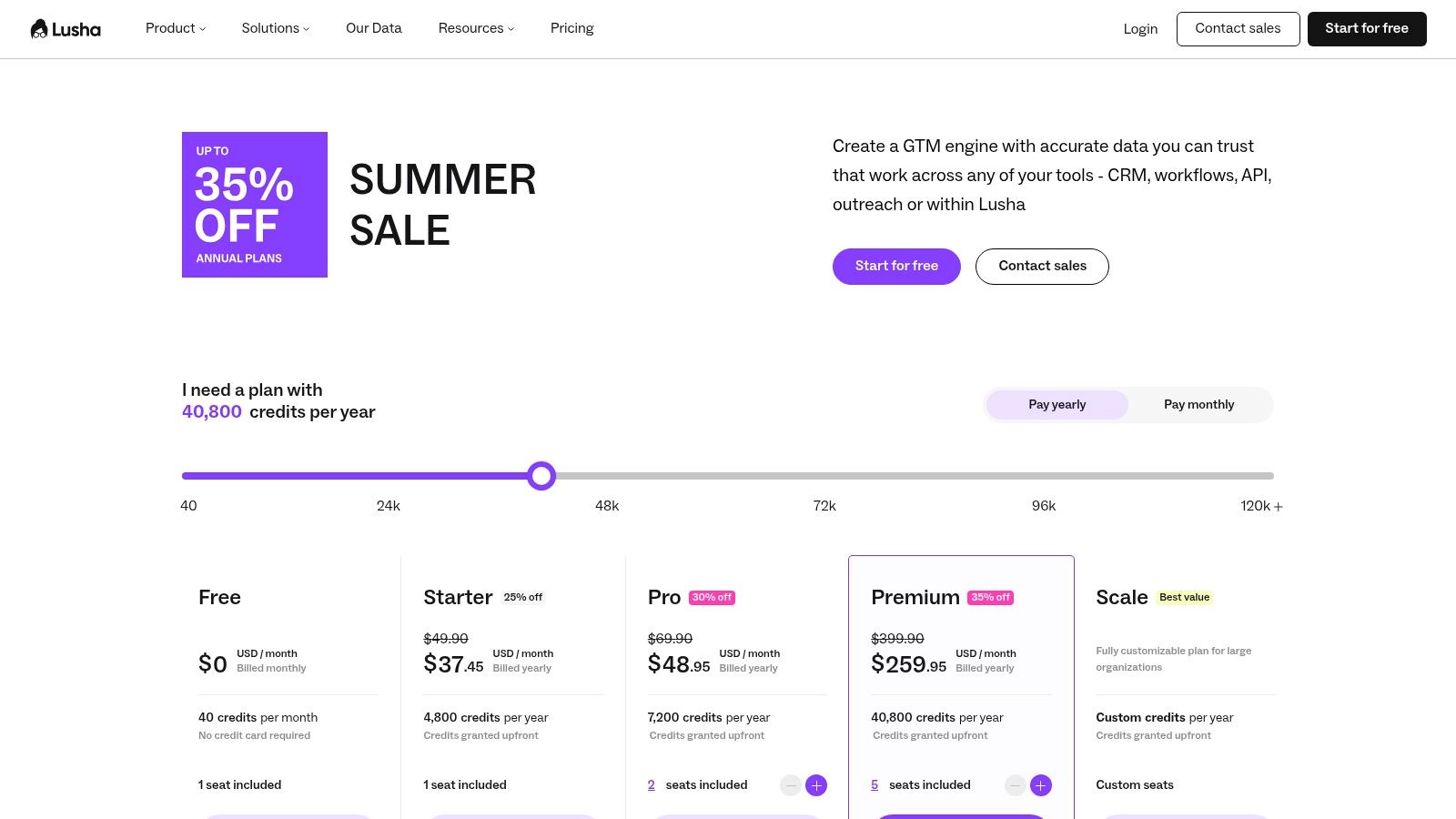
Lusha uses credits, and phone numbers consume more credits than lighter contact lookups. Buyers should therefore test their real mix of email, mobile, company records, and CRM enrichment instead of evaluating the tool only through a small sample search. Coverage depth can also vary by region and persona, with specialized competitors offering a stronger fit for some mobile-heavy or EMEA requirements.
Pricing details aren't fully exposed publicly, so procurement should ask for clear definitions of included credits, rollover behavior, API usage, seats, and enrichment costs. A simple user experience doesn't guarantee a simple total cost.
Best fit: Individual reps, SMB teams, and LinkedIn-centric prospecting workflows.
Implementation friction: Low, particularly for extension-led capture and basic CRM connections.
Limitations: Pricing transparency is incomplete, phone usage can consume credits quickly, and coverage may trail specialized providers in selected regions.
Lusha is most compelling when the team's bottleneck is finding contact details during active research. It's less suitable as the sole system for market-wide extraction, complex governance, or multi-stage outbound orchestration.
6. UpLead
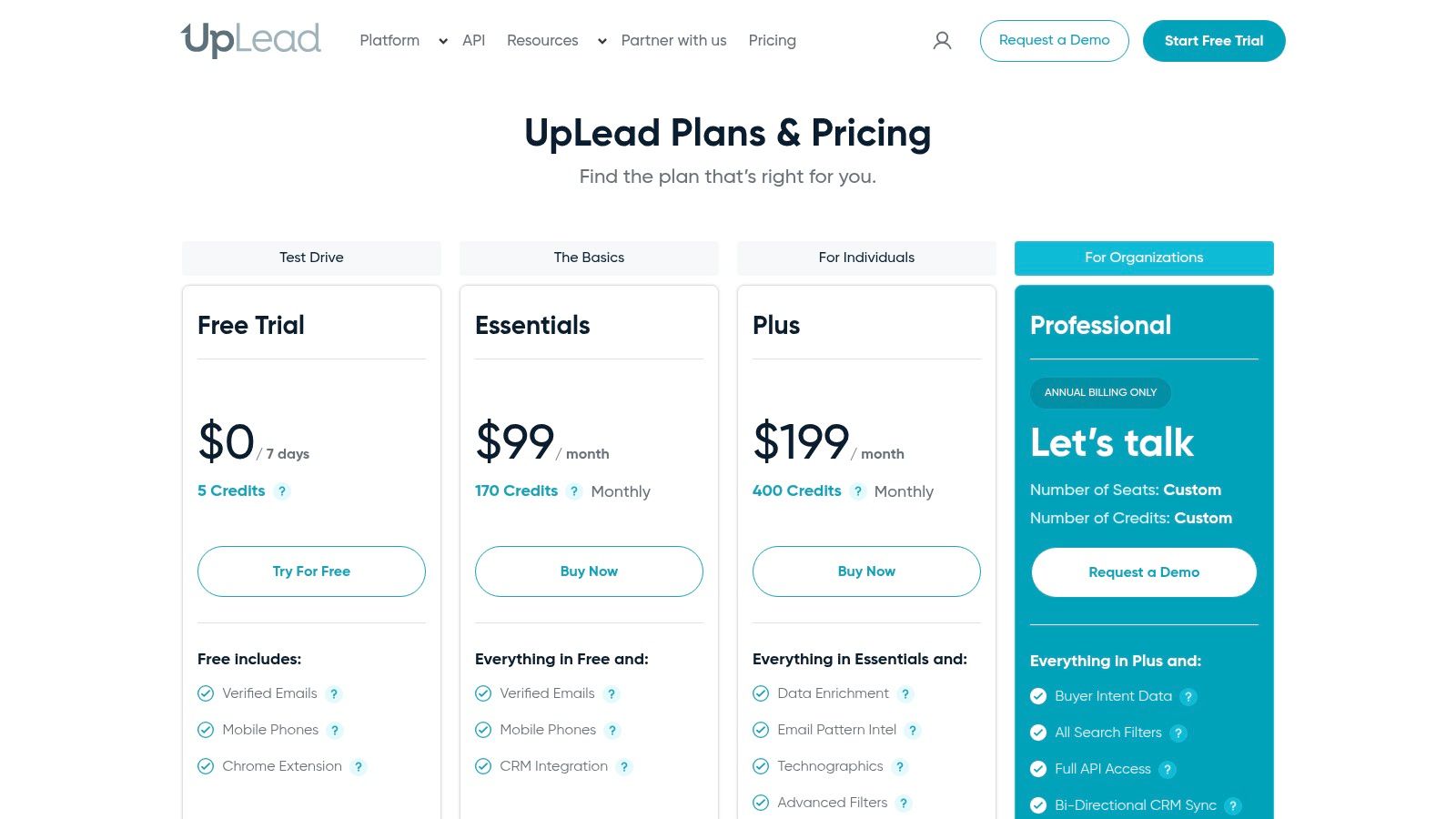
UpLead puts data cleanliness and deliverability at the center of its proposition. It offers real-time verification at download, an enrichment API, technographic filters, and buyer-intent signals on higher plans. Its public accuracy guarantee promises 95% accuracy, with credit refunds for invalid contacts (UpLead pricing).
The guarantee is useful because it converts an abstract data-quality claim into an evaluation condition. It still needs careful interpretation. A valid email can belong to the wrong person, a role-based inbox, or an account that no longer fits the target profile. Buyers should test the fields that matter downstream, including seniority, industry, geography, technology use, and CRM matching.
A clean import layer for lean teams
UpLead's self-serve pricing and clear credit definitions reduce procurement friction. The platform suits teams that want to search, verify at export, and send cleaner records into a CRM or engagement system without buying a broad enterprise suite. Technographic filtering adds value for software vendors and agencies with technology-specific targeting.
The database is smaller than the largest vendors, so niche personas and less-covered regions may produce lower match rates. Essentials and Plus plans are single-user, while team functionality requires Professional, which changes the fit for a growing SDR organization.
Best fit: Teams prioritizing verified email data, clean CRM imports, and transparent self-serve evaluation.
Implementation friction: Low for individual use, moderate when team permissions and shared workflows are required.
Limitations: Smaller database breadth, potentially weaker niche or regional coverage, and plan restrictions for multi-user teams.
The best test is not whether UpLead returns a large list. Compare the proportion of records that satisfy your ICP, pass verification, map cleanly to existing CRM records, and remain usable after routing.
7. Hunter
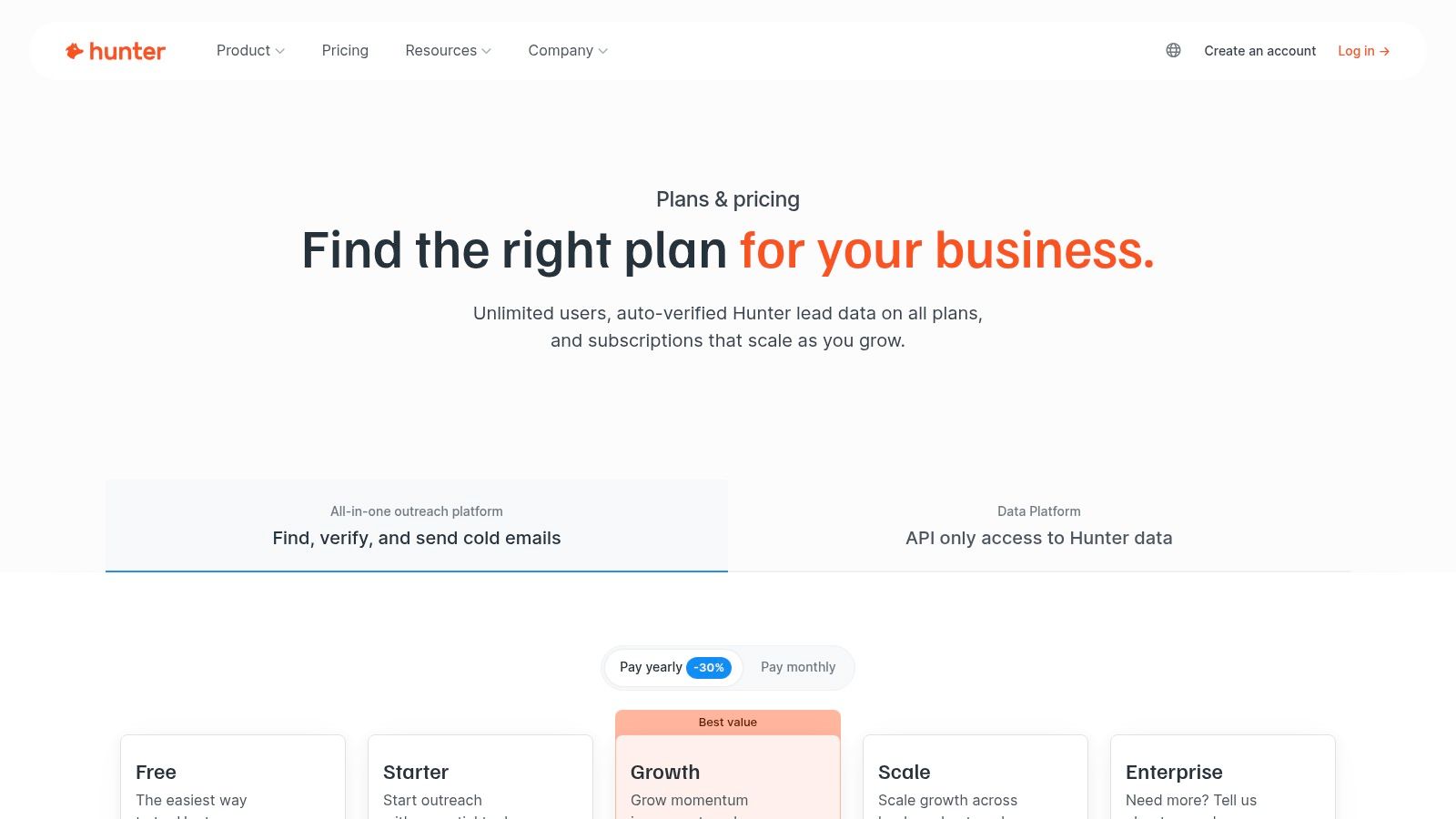
Hunter is an email-first lead generation platform for finding addresses by domain, locating individual emails, processing bulk lists, and verifying records through an API. It also includes lightweight sequences, tracking, browser extensions, and a Google Sheets add-on, so it can fit into an existing stack without replacing every sales system.
The product is strongest when the question is simple: “What is the likely professional email for this person or domain, and is it safe to use?” Domain Search and Email Finder support discovery, while the verifier helps separate potentially usable records from addresses that need suppression or additional review. That division is clearer than in broad suites where data, intent, engagement, and enrichment are bundled together.
Keep the surrounding stack in view
Hunter's pricing is comparatively clear, and pooled team credits make it practical for groups that share verification work. Its limited phone coverage means it won't replace a mobile-focused provider for calling-led SDR teams. Intent and account-level signals are also lighter than those found in ABM-oriented platforms.
The Hunter alternative overview from MapLeads can help frame the choice, but the right comparison depends on whether your team already has a source of company records. Hunter can be an efficient verification and email-discovery component even when another tool supplies the initial list.
Best fit: Email-first teams, agencies processing domains in bulk, and organizations adding verification to an existing CRM or prospecting workflow.
Implementation friction: Low, with straightforward API, spreadsheet, and browser-based use.
Limitations: Limited phone data, lighter intent signals, and less support for broad market discovery.
Hunter is often better as a focused component than as a complete revenue-data system. Its value rises when the team has already decided where prospects come from and needs a dependable email workflow.
8. LeadIQ
LeadIQ is built around the SDR action loop: capture a person or company from LinkedIn or the web, enrich the record, and push it into a CRM or engagement tool. Its Chrome extension, people and company search, webform enrichment, job-change tracking, and AI message writer all support that motion.
The distinction matters because many data platforms optimize for list creation by operations teams, while LeadIQ is designed for a rep working inside active research. The rep doesn't need to export a large market file first. They can capture a relevant contact at the moment of discovery and send the record into the next system with less manual copying.
Capture quality still determines downstream value
LeadIQ's clear per-credit logic and free tier make piloting accessible. Buyers should monitor the relationship between captured contacts, enriched fields, CRM acceptance, and actual outreach. Phone use can exhaust credits quickly because mobile enrichment consumes more than lighter actions, so a calling-heavy team needs a different cost model from an email-led SDR team.
Database breadth is smaller than the largest vendors. That's not necessarily a weakness for a rep-centric workflow, but it becomes one if the team expects complete market mapping across many countries, categories, or hard-to-find personas.
Best fit: SDR teams that need browser capture, enrichment, and direct export into CRM or sales engagement systems.
Implementation friction: Low to moderate, especially when CRM field mapping and duplicate handling are already defined.
Limitations: Smaller database breadth and potentially rapid credit consumption for phone-heavy workflows.
LeadIQ is a strong fit when the rep has already found the relevant account or person. It's less appropriate when the business needs to discover an entire local market before identifying individual contacts.
9. Seamless.AI
Seamless.AI uses a real-time discovery model for emails and cell phones, with buyer intent, job-change tracking, enrichment, an API, and a Connect module for light email, call, and task workflows. It appeals to teams that want data and basic outbound actions in one interface without committing immediately to a larger enterprise platform.
That real-time orientation changes the evaluation question. A prebuilt database is convenient for repeatable searches, while on-demand discovery may help with less obvious or recently changed contacts. It can also make results less predictable, so buyers should measure match quality across their own segments rather than assuming that “real time” automatically means accurate.
Broad coverage, less predictable commercial detail
Seamless.AI offers a self-serve entry point with free credits and packaged outbound features. The interface can cover more of the workflow than an email-only finder, but pricing for intent, Autopilot, enrichment, and other add-ons isn't fully itemized publicly. Daily throttles or fair-use limits may also affect high-volume operating models.
The platform's best fit is a cost-conscious team that wants email and cell discovery plus light engagement. Teams that need deep governance, highly structured CRM enrichment, or a specialized verification standard should compare it against focused providers rather than judging it as a full replacement for every component.
Best fit: Individual SDRs and small teams seeking contact discovery with basic outbound execution.
Implementation friction: Low for initial adoption, moderate when usage controls and CRM processes become central.
Limitations: Some pricing and add-ons lack public detail, and high-volume usage may be subject to throttling or fair-use rules.
The commercial risk is not only the subscription price. It's the operational uncertainty created when a team can't forecast credits, limits, and enrichment behavior against its planned prospecting volume.
10. Snov.io
Snov.io consolidates an email-first outbound workflow: find prospects, verify addresses, create multichannel campaigns, warm inboxes, monitor deliverability, and manage follow-up in a lightweight CRM. That makes it a practical option for teams that want fewer handoffs between discovery and sending.
Its seven-tier email verification process gives the user more visibility into how a record was assessed before it enters a campaign. The platform also supports LinkedIn steps, API integrations, and self-serve scaling. For an email-led motion, that combination can reduce the need to pair a separate finder, verifier, warm-up service, and basic sequencer.
A compact outbound system
Snov.io's competitive advantage is workflow continuity. The team can move from find to verify to warm up to send inside one interface, while higher plans offer unlimited team seats. Credit and recipient definitions should still be reviewed carefully, particularly for agencies managing multiple client campaigns or teams with shared prospect pools.
Phone and mobile coverage is limited compared with data-heavy vendors, so Snov.io isn't designed for a calling-first organization. LinkedIn automation slots are billed separately, which can affect the overall cost of a multichannel program.
The MapLeads email list workflow provides a useful comparison point for teams deciding whether they need broad business extraction first or an email-centered campaign environment.
Best fit: Small teams and agencies seeking a budget-conscious, email-led outbound workflow.
Implementation friction: Low to moderate, with deliverability setup and compliance controls still requiring deliberate configuration.
Limitations: Limited phone coverage, separate billing for LinkedIn automation, and less suitability for enterprise-grade data governance.
Snov.io makes sense when the campaign starts with email and ends with email-driven follow-up. It's a weaker choice when the primary challenge is discovering businesses, supplying verified direct dials, or orchestrating complex account-level buying signals.
Top 10 B2B Lead-Gen Software Comparison
| Product | Key capabilities | Quality & UX | Unique selling points | Audience & Price |
|---|---|---|---|---|
| MapLeads 🏆 | Tri‑source map scraping (Google/Apple/Bing), verified enrichment (emails, phones, socials), exports (CSV/Excel/JSON), API/webhooks, de‑dup | ★★★★★, managed cloud jobs, uniform schema, large‑scale runs | ✨ Tri‑source + single workflow, ✨ BillionVerify included, ✨ refunds for failed/undersupplied searches, ✨ no proxies/CAPTCHA | 👥 B2B SDRs, agencies, local SEO, recruiters, DevOps; 💰 Lite $50/mo (15k leads), Pro $100, Max $200; 3‑day trial |
| ZoomInfo SalesOS | Enterprise contact & company data, intent, org charts, visitor ID, integrations | ★★★★★, deep US firmographics, scalable integrations | ✨ Intent bundles & buying‑committee views, ✨ broad product suite (Sales/Marketing/Operations/Talent) | 👥 Large SDR/marketing/ops teams; 💰 Enterprise/quote pricing (annual/seat/credit models) |
| Apollo.io | B2B database + enrichment, engagement (sequences, dialer), basic CRM, API | ★★★★, solid UX, self‑serve onboarding | ✨ Built‑in engagement (sequences + dialer), ✨ free plan for trialing | 👥 SMB → mid‑market sellers; 💰 Free tier + self‑serve paid plans |
| Cognism | Phone‑verified mobile numbers, DNC screening, compliance tooling, enrichment | ★★★★, strong EMEA/UK phone quality & privacy focus | ✨ Diamond Data phone verification, ✨ GDPR‑aware tooling | 👥 Calling‑led teams in Europe/UK; 💰 Quote‑only, premium pricing |
| Lusha | Prospect search, AI Workspace, browser extension for LinkedIn, enrichment | ★★★, fast extension workflows, easy setup | ✨ Extension‑first LinkedIn capture, ✨ AI prospect tables | 👥 SMBs and LinkedIn‑centric teams; 💰 Free tier + paid credit plans |
| UpLead | 95% accuracy guarantee, real‑time verification at export, technographic filters | ★★★★, emphasis on deliverability and CRM import quality | ✨ Public accuracy guarantee + refunds, ✨ real‑time verification API | 👥 Teams prioritizing data cleanliness; 💰 Transparent credit pricing (self‑serve) |
| Hunter | Domain search, email finder (single/bulk), email verifier, light sequences | ★★★★, clear UX for email workflows, generous verification | ✨ Strong bulk verification, ✨ easy stack integration | 👥 Email‑first teams and marketers; 💰 Affordable plans + pay‑as‑you‑go options |
| LeadIQ | Chrome capture, people/company search, CRM push, job‑change tracking | ★★★, SDR capture → enrich → export focus | ✨ Purpose‑built SDR capture workflows, ✨ CRM push automation | 👥 SDR teams and recruiters; 💰 Clear public pricing, free trial tier |
| Seamless.AI | Real‑time email & cell discovery, intent, job‑change tracking, Connect module | ★★★, broad discovery, some throttles on high volume | ✨ Real‑time cell + email discovery, ✨ integrated light engagement | 👥 Cost‑conscious teams needing cell coverage; 💰 Self‑serve with free credits; some fair‑use limits |
| Snov.io | Email finder + multi‑step verification, multichannel drip, inbox warm‑up, lightweight CRM | ★★★, end‑to‑end email workflow at budget price | ✨ Built‑in warm‑up & deliverability tools, ✨ sequencer + verifier in one UI | 👥 Budget sales/outbound teams; 💰 Competitive credit pricing, scalable plans |
Build the Smallest Stack That Fits
There isn't a universal winner because these platforms solve different workflow failures. The sensible choice is the smallest stack that covers your actual path from market definition to usable contact to measured pipeline. A team that buys a broad database when it really needs local-business discovery may create more records without improving targeting. An email-first team that buys enterprise intent may gain complexity before it gains a better next action.
Start by testing the top two or three candidates against the same target segment. Give each platform the same geography, business category or industry, role requirements, required contact fields, CRM destination, export volume, and outreach workflow. Use the same acceptance rules for verification and duplicates. That creates a fair comparison between MapLeads, Apollo, Hunter, UpLead, or any broader suite instead of allowing each vendor to define success with a different sample.
The market context supports a disciplined approach. 91% of marketers rank lead generation as a top priority, while 58% of B2B marketers identify high-quality lead generation as their biggest challenge, and 44% of companies use marketing automation to generate leads (Wise Guy Reports). Those figures describe demand and difficulty, not proof that one platform will solve a particular team's pipeline problem.
Match the platform to the motion
Choose an enterprise suite such as ZoomInfo when governance, cross-functional data, intent, org charts, visitor identification, and scalable integrations matter more than self-serve simplicity. Choose Cognism when a calling-led European motion makes verified mobiles and privacy tooling central. Choose LeadIQ or Lusha when SDRs need browser capture and fast enrichment while researching accounts. Choose Hunter or Snov.io when verified email and deliverability are the core requirement.
Agencies and local-market operators should look closely at MapLeads because repeatable multi-market extraction, tri-source coverage, standardized exports, deduplication, and API or webhook automation address a different problem from contact-database lookup. A team can use it to build a structured business universe before applying enrichment, segmentation, CRM routing, and outreach rules. That distinction is often missed in software comparisons that assume every prospecting workflow begins with a known company or person.
Don't compare tools by raw record count. Compare the number of records your CRM accepts, your team can lawfully contact, and your revenue process can trace to pipeline.
Measurement also needs updating. The traditional MQL model is under pressure, and a 2025 industry brief reports that 68% of B2B buyers consult an LLM during research, while major attribution platforms may fail to capture that touchpoint (The Starr Conspiracy). That makes raw lead volume an increasingly weak success metric. Teams should track source quality, verification outcomes, account engagement, accepted opportunities, sales activity, influenced pipeline, and the points where AI-assisted research remains invisible.
Data quality deserves the same scrutiny. One 2025 report identifies personalization as a challenge for 36% of practitioners, daily outreach limits for 35%, analytics access for 19%, and safety for 14% (Belkins lead generation trends). Another analysis reports annual contact-data decay of 34%, which is why refresh mechanisms, source diversity, suppression logic, and CRM hygiene matter more than a one-time export (Belkins data analysis). Where a source provides multiple related findings, treat them as reasons to test your own records, not as guarantees of performance.
Before signing, document who owns verification, opt-outs, duplicate resolution, enrichment refreshes, CRM field governance, and attribution. Validate a representative sample, record the limitations, and measure usable contacts and pipeline contribution, not just how many leads a platform can generate.
For teams comparing category options, a broader B2B lead generation guide from Voicedial.ai can provide additional context, but your final decision should come from a controlled workflow test. The platform that wins is the one your team can operate consistently, integrate cleanly, govern responsibly, and connect to revenue evidence.
MapLeads gives teams a cloud-based way to extract public business data from Google Maps, Apple Maps, and Bing Maps, then enrich and export records with verified emails, phones, websites, social profiles, and standardized metadata. If your workflow starts with discovering businesses across categories or markets rather than searching a fixed contact database, visit MapLeads to evaluate its multi-source extraction, deduplication, exports, API, and webhook options.