Local Business Leads: How to Source and Convert Them
Discover proven channels for sourcing local business leads, from maps and directories to events. Learn tactical outreach steps that turn raw data into pipeline.
Most advice about local business leads starts in the wrong place. It treats local discovery like a visibility contest, as if the only problem is getting a business to show up a little higher in maps or organic results. In practice, the harder problem is what happens after someone finds you, because local lead generation breaks when data is incomplete, unverified, or impossible to move cleanly into a CRM.
That matters because local search demand is already enormous. A major review of local SEO data says 46% of Google searches have local intent, 80% of U.S. consumers search for local businesses weekly, and 32% search daily, yet businesses still report lead generation as their top challenge WiserReview. The issue isn't getting found. It's turning map views, directory hits, and high-intent clicks into records a sales team can work.
Why Local Lead Generation Is a Data Problem Not a Traffic Problem
Local teams usually chase rankings because rankings are visible. You can point to a map pack position, a profile view, or a citation audit and feel like progress is happening. But visibility without usable records doesn't move revenue, and that's where a lot of local business leads content falls apart.
The bottleneck shows up after discovery
Local search behavior is already compressed. People search, compare, read reviews, and act quickly, which means the moment of opportunity is short. When the business data behind that search is messy, the window closes fast. Missing phone numbers, outdated hours, duplicate listings, and inconsistent categories all make the lead harder to route, score, and follow up on.
Practical rule: if a local listing can't be turned into a clean CRM row in one pass, it's not finished yet.
That's why the better question isn't “How do we rank?” It's “How do we capture the right fields, verify them, and make them usable before the prospect disappears?” Search visibility still matters, but it's upstream of the core work. The core work is data capture, normalization, and handoff.
Lead generation fails when workflow friction wins
Sales teams don't lose because they lack traffic alone. They lose because the path from discovery to outreach is full of small failures. One bad email, one stale website, one duplicate record, and a rep wastes time on a contact that should've been filtered earlier.
That's also why local business leads deserve more operational attention than generic SEO advice gives them. If the same high-intent visitor can't be traced into a list, cleaned, and segmented, then the business has paid for attention it can't convert. The fix is usually not another ranking tweak. It's a better system for capturing the intent that's already there.
Where Local Business Leads Actually Come From
The channel mix matters because it tells you where to spend effort first. One independent industry analysis found that organic search generated 31% of local-business leads, local listings and maps generated 28%, and paid search generated 27%, which means 86% of all reported local leads came from search channels combined Neil Patel. That's the core takeaway, search dominates, and listings are close enough to organic that they can't be treated like a side project.
Search channels carry most of the load
When search produces the majority of local leads, every listing field starts to matter more. Business name, category, address, phone, website, and hours aren't admin details. They're conversion infrastructure. If they're wrong or missing, the lead source loses value before sales ever sees it.
That also explains why map-based discovery is so important for local teams. Directory and map results often surface before a site visit, so the business that shows up with complete information has a real advantage. The lead may never touch a landing page first. It may go straight from search to call, direction request, or review scan.
Why listings deserve a pipeline mindset
The right way to read the data is simple. Organic search still matters, but local listings and maps are nearly as productive, and that makes them a core acquisition channel rather than a support channel. If your team wants a practical benchmark for how local lead generation is discussed in the market, the local lead-focused analysis at ThroughTheGrapevine.ai local leads is a useful companion because it keeps attention on sourcing and activation, not just rankings.
That distribution changes the operating model. Instead of asking which channel is “best,” the better question is which source gives the cleanest records with the least cleanup. For many teams, that's the source they can reliably structure, enrich, and push into outreach the fastest.
Comparing Lead Sourcing Channels for Local Markets
Public directories and local listings usually win on effort versus payoff because the data is already structured. They bundle the core fields you need, such as name, location, category, phone, and website, in one place MailBeast. That means less cleanup, fewer missing fields, and a shorter path to outreach.
The channel trade-offs are not equal
Google Maps gives broad reach, but it can be messy when businesses have duplicate profiles or inconsistent metadata. Apple Maps helps cover prospects who don't live inside Google's ecosystem all day, though it often needs more verification work. Bing Maps can fill gaps that the other two miss, especially for broader coverage across the web's long tail.
Industry directories are often underrated because they're boring. They're also useful because they compress discovery and structuring into the same source. Local events and social platforms can surface businesses that don't show up cleanly in map results, but they usually take more manual work to turn into records. That makes them better for targeted prospecting than for repeatable list building.
Useful filter: if a source gives you structured business fields at the start, it saves time later even when the list is smaller.
Local Lead Sourcing Channels Compared
| Channel | Data Completeness | Verification Effort | Coverage | Best For |
|---|---|---|---|---|
| Google Maps | High, but uneven | Moderate | Broad | General local prospecting |
| Apple Maps | Moderate | Moderate to high | Good coverage gaps | Reaching non-Google users |
| Bing Maps | Moderate | Moderate | Useful secondary coverage | Supplemental discovery |
| Industry directories | High | Low to moderate | Niche and vertical specific | Fast list building |
| Local events | Low to moderate | High | Local and timely | Relationship-led outreach |
| Social platforms | Low | High | Fragmented | Contextual prospecting |
The table makes the trade-off clear. The sources with the fastest route to usable data are usually not the flashiest ones. The more manual the source, the more it behaves like research work instead of repeatable pipeline generation.
For that reason, a tri-source approach is smarter than locking into one platform. If you only use one map ecosystem, you'll miss businesses. If you use all three and deduplicate carefully, you widen coverage without letting records drift apart. That's where the advantage lives.
Extracting and Enriching Leads from Map Platforms
Manual copy and paste is fine for a handful of prospects. It falls apart the moment you need repeatable volume. The reasons are obvious, humans miss fields, format data inconsistently, and spend too much time bouncing between tabs instead of qualifying the right businesses.
Start with capture, not enrichment
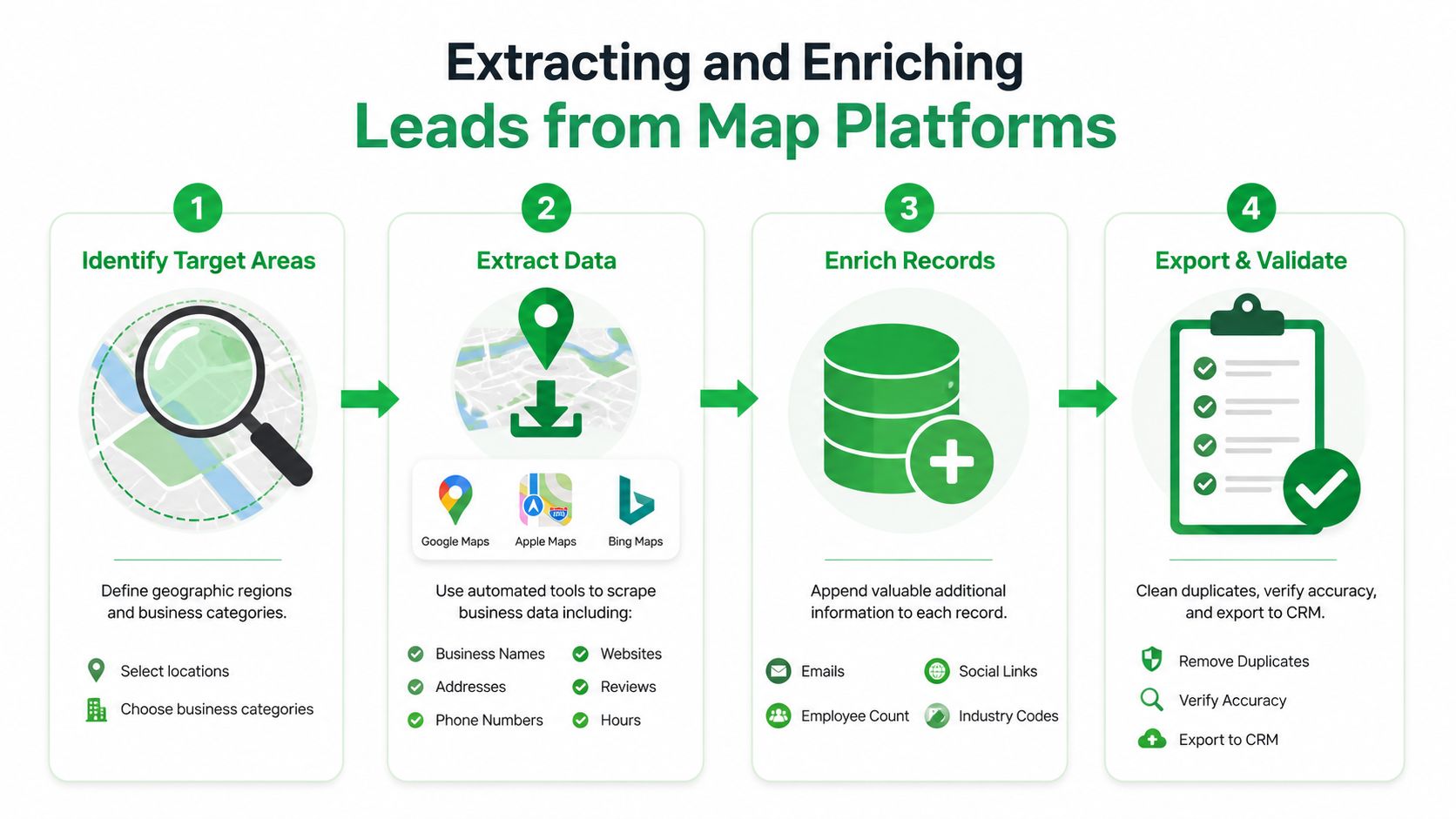
The first job is to define the target area and business category clearly. If the search scope is vague, the list becomes a pile of unrelated businesses that look busy but don't match a campaign. Narrowing the geography and category first keeps the output usable later.
Then extract the listing data into a consistent schema. A tool like MapLeads Google Maps scraper can fit into that workflow because it pulls public business data into exportable fields instead of leaving reps to transcribe everything by hand. That matters when you want records that can move into CRM, enrichment, and sequencing without custom cleanup every time.
Verify before you send
Email verification is not a nice-to-have. Invalid mailboxes and dead domains drive bounces, and one campaign case study showed verification reducing bounce rate from 6.8% to 1.1% BounceBuster. That's a big operational difference, because bounce-heavy lists waste sender reputation and make future outreach weaker.
Use the extraction stage to standardize the obvious fields, then enrich only the records worth pursuing. Add verified emails, phone numbers, social profiles, hours, and review signals after you've removed duplicates. That sequencing keeps your list lean and your follow-up cleaner.
A practical rule for teams is to treat extraction as the source of truth and enrichment as a controlled layer on top. If a record can't be verified cleanly, it shouldn't enter the sequence just because the business exists. The point is to build a list that a rep can work tomorrow without second-guessing every row.
Adapting to AI-Era Local Discovery and Multi-Platform Search
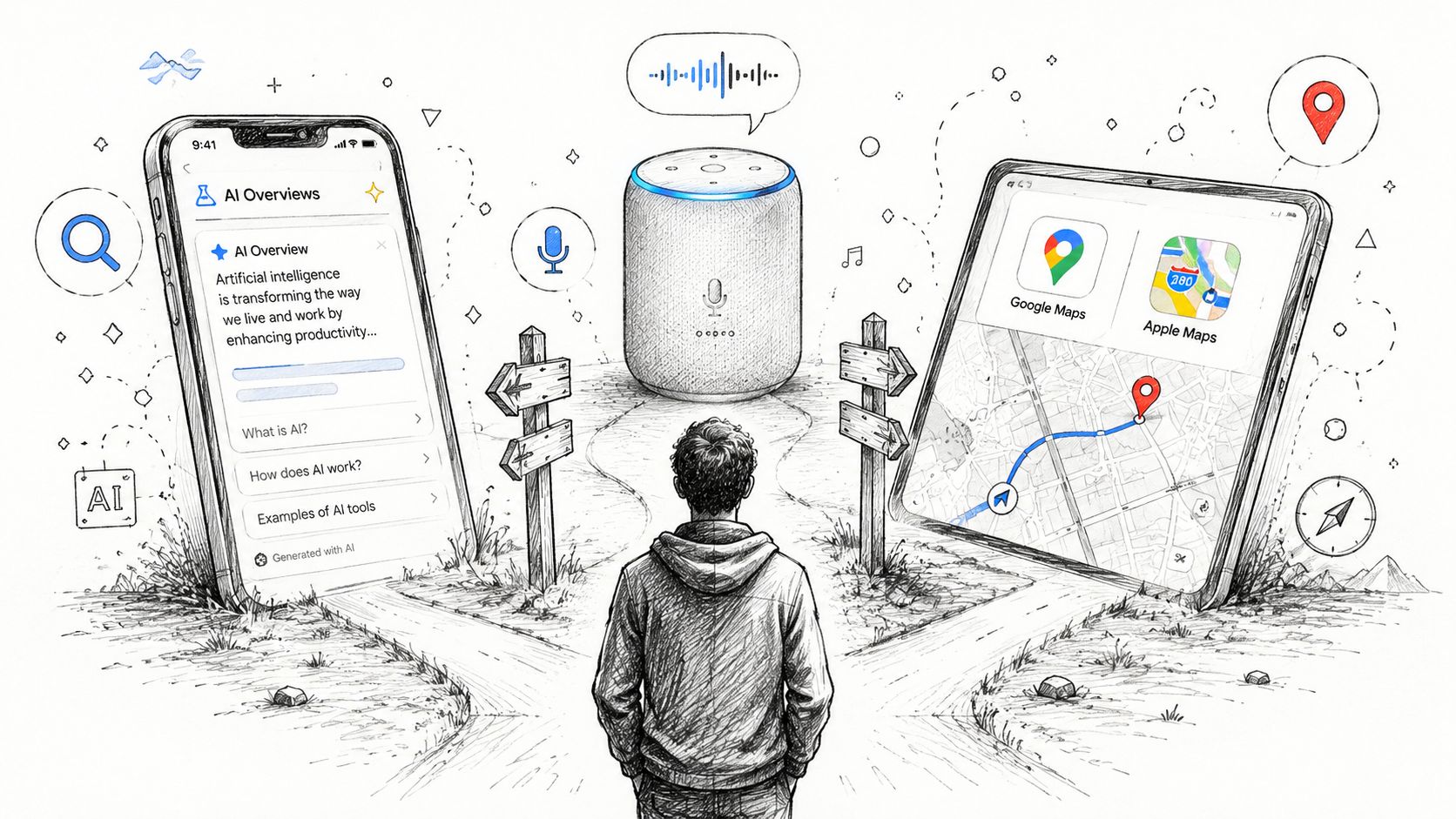
Local discovery isn't living in one place anymore. AI summaries, map apps, and search engines all shape what people click next, and that changes what counts as “visible.” Recent coverage says AI Overviews now appear in a substantial share of local queries, with one source reporting 32% coverage of local queries, and another noting that Google's AI Overviews are available across 200+ countries and 40+ languages OnTheMap.
AI changes the click path
When AI answers sit above or alongside traditional results, the prospect may never follow the old map-to-site route. They may read the summary, inspect reviews, or choose from a compact set of surfaced businesses. That means local lead systems need to capture the business before the click path gets too narrow.
The practical response is to store more than just a name and phone number. Keep source URLs, category data, hours, reputation signals, and platform identifiers wherever possible. Those fields help you dedupe and route leads when the same business appears differently across search surfaces.
For operators who want to think about reputation in this new environment, the discussion at Surva.ai beyond Google Business Profile signals is useful because it frames local visibility as a broader signal set, not a single profile problem.
Coverage gaps still matter
Google still dominates local discovery, but Apple Maps and Bing continue to matter where coverage is uneven. The question isn't whether one platform wins. It's whether your pipeline can absorb what each platform surfaces and merge it cleanly. If not, you end up with fragmented records and duplicate outreach.
That's why AI-era local lead generation is really an orchestration problem. A business needs intake across multiple discovery surfaces, a dedupe layer, and a way to enrich records without overwriting the original source data. Teams that get this right don't just rank better. They capture more of the market that search already exposes.
Turning Raw Lead Lists into Qualified Pipeline
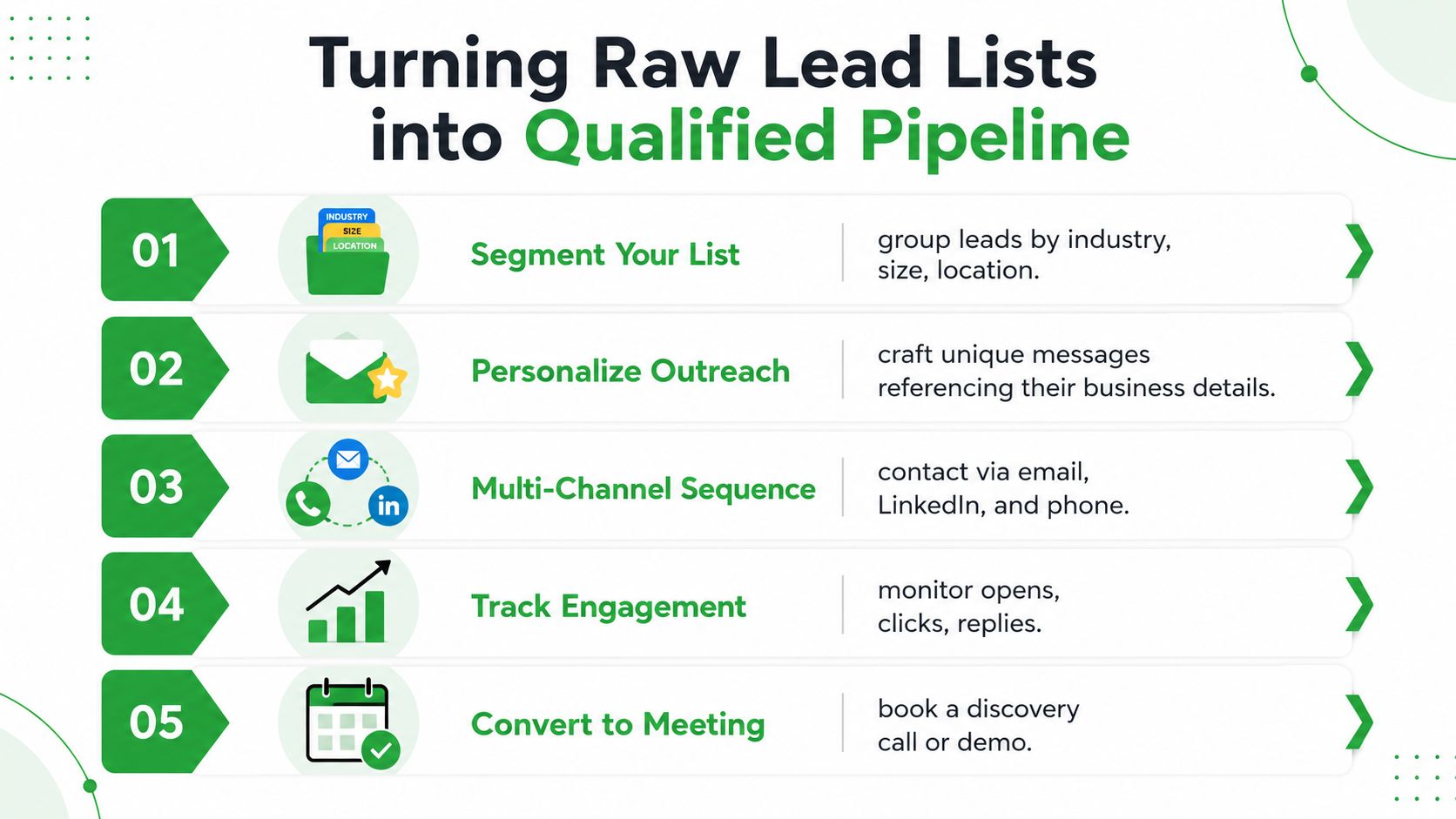
A raw list of businesses isn't pipeline. It's only useful when it gets segmented, personalized, and worked with enough discipline that the right people answer. Local buyers can tell when outreach is generic, and local sales cycles punish sloppy sequencing because the market is small enough to notice repetition fast.
Segment by business reality, not just geography
Segment lists by category, location, and reputation profile before a rep ever writes. A dental practice with strong reviews deserves a different opener than a new location with thin visibility. Opening hours also matter, because local business owners and managers don't all check email at the same rhythm.
Use the data you already captured to shape the message. A line that references the business category or a specific review signal will outperform a copy-pasted intro because it proves the rep did the work. That's especially important in local markets where the first reply often comes from the owner, not a procurement process.
Work the list with a real cadence
The best outreach sequence is the one that matches how local operators work. Email can start the conversation, but a phone call or social touch can help when inboxes are busy and the business is small. If you need human help setting that motion in motion, Hire Appointment Setters is one route teams use when they want the list worked consistently instead of sporadically.
Practical rule: use the listing data to make the first line specific, then use the sequence to earn the second conversation.
Track what happens after send. Open rates alone won't tell you which source produced useful pipeline. Monitor replies, meetings booked, and which segments convert by category and source. If one map source creates cleaner records and better reply quality, that source deserves more weight in the next extraction cycle.
If you're using MapLeads email lists or any comparable export, the point is the same. The list should already be structured enough that segmentation and personalization happen fast, not as a rescue operation after import.
Building a Repeatable Local Lead Generation System
The teams that do this well stop treating local lead generation like a campaign and start treating it like infrastructure. They set recurring extraction jobs, keep verification in the workflow, and let dedupe rules protect the CRM from becoming a junk drawer. That makes the system easier to manage and much harder to break.
A simple operating loop
A sales manager might run the process like this. First, the team pulls businesses from Google, Apple, and Bing in a defined geography. Then the list is merged, deduplicated, and filtered so only viable accounts move forward. After that, the team verifies contact fields, adds the most useful enrichment, and pushes the cleaned records into outreach templates.
The gain comes from consistency. Standard columns keep templates stable, and stable templates make testing easier. Once the team sees which categories produce meetings and which sources create cleanup work, they can adjust the search inputs instead of rebuilding the process every week.
Build feedback into the workflow
Feedback loops matter more than dashboards. If a certain category repeatedly produces bad contact data, that pattern should change the next extraction, not sit in a quarterly report. If one source returns more complete records, the team should prioritize it until the quality drops.
Teams using MapLeads quickstart documentation can use that kind of operating model to reduce setup friction, especially when the goal is recurring list generation rather than one-off scraping. The point is to keep the data flow predictable enough that sales can trust it.
Local business leads are won by teams that can convert search visibility into clean, verified, usable records faster than competitors can. If you want a workflow built around extraction, verification, and CRM-ready output across Google, Apple, and Bing, visit MapLeads and see how the pipeline can start from structured local data instead of manual list building.