Web Scraping vs API: Which Data Path Fits Your Needs?
Web scraping vs API explained with side-by-side criteria on reliability, coverage, rate limits, and legality so you can pick the right data access method.
The popular advice says APIs are cleaner, safer, and therefore the obvious choice. That advice is neat, but it breaks down fast once you care about operational resilience, coverage, and governance at scale. In practice, the better question isn't whether an API is more elegant than scraping, it's which path keeps delivering usable data when quotas tighten, schemas drift, or a vendor changes the rules midstream.
| Criterion | API | Web Scraping |
|---|---|---|
| Reliability | Strong when the contract stays stable | Strong when targets are simple and well governed, weaker when layouts change |
| Coverage | Limited to what the provider exposes | Can reach publicly visible data the provider doesn't model |
| Rate controls | Server-side ceilings and quotas | Limited by your infrastructure, anti-bot defenses, and target complexity |
| Maintenance | Lower if the endpoint stays intact | Higher because selectors, rendering, and site changes need ongoing care |
| Governance | Usually clearer contracts and permissions | Requires more care around access rules, reuse, and auditability |
Why the Web Scraping vs API Question Is Misadgedged
The standard debate assumes APIs are automatically cleaner and scraping is automatically rougher. That framing is too shallow for teams that ship data pipelines. The core issue is whether your access method survives changing constraints, not whether it looks nicer in a diagram.
A better way to evaluate web scraping vs API is through five axes, reliability, coverage, rate limits, maintenance, and legality. Those are the factors that decide whether data lands in Snowflake every morning or whether an integration degrades until someone notices a missing feed. The market itself shows why this matters, web scraping is no longer a side tactic, it's a distinct industry, with the market valued at USD 1.34 billion in 2025 and forecast to reach USD 3.49 billion by 2031 in one report, while another placed the broader web scraping software market at USD 1.01 billion in 2024 with a projection to USD 2.49 billion by 2032 Mordor Intelligence.
The framing error teams keep making
Teams usually optimize for the method they already know, not for the shape of the source or the governance burden. That leads to bad defaults, like forcing an API integration for a data source that only exposes part of the field set, or building a scraper when the data is regulated and the contract needs to be explicit. The right decision starts with what the source publishes and what your business is allowed to do with it.
APIs also aren't immune to strategic friction. Modern enterprise usage shows APIs are the dominant standardized channel, with one 2026 industry summary reporting that 90% of developers use APIs and 83% of all web traffic is API-based, while another cited 82% of organizations identifying as API-first in 2026, up from 74% in 2024 API statistics summary. That scale is useful, but it also means APIs have become a governed distribution layer with quotas, pricing, and product decisions that can move against you.
The wrong comparison is “clean versus messy.” The useful comparison is “what fails first, and how expensive is the failure?”
For a practical alternative when public map data is the target, see MapLeads alternatives, which sits in the same broader decision space as managed extraction tools.
How Each Method Actually Works in Practice
An API is a contract. You authenticate, send a structured request, and receive a structured response that follows a documented schema. The provider controls pagination, quotas, and the field set, which means the downstream system gets typed records with predictable identifiers and far less parsing work.
Web scraping works differently. Your system fetches a page, renders it if needed, parses the HTML or DOM, and extracts fields by reverse-engineered selectors or rules. That makes scraping more flexible, but it also means you absorb the cost of layout changes, anti-bot responses, and site-specific quirks every time a target shifts.
What downstream pipelines actually receive
An API usually returns stable objects that are easier to normalize, validate, and join. Scraping more often returns raw or semi-structured output that needs cleanup before it's useful. The difference shows up fast in production, because schema drift in an API is usually visible, while selector drift in scraping can be silent.
The mechanics matter here. API integrations rely on auth tokens, pagination, and rate enforcement. Scraping pipelines rely on proxy rotation, headless rendering when JavaScript is involved, and change handling when a site moves fields around. That's why managed extraction layers have become popular, they absorb parts of the fragile work while still giving teams data in an API-like shape.
A useful practical reference for teams wiring these flows into real systems is scraping API integration tips from Sota Proxy, especially if you're standardizing retries, pagination, and extraction logic across multiple sources.
Practical rule: if your downstream consumers need stable field names and auditable payloads, the API shape is easier to operationalize. If the provider leaves important fields out, scraping becomes the only way to recover them.
If you're working from a documented endpoint set, MapLeads API reference shows what a public, versioned workflow looks like in a maps extraction context.
Comparing the Two Approaches Side by Side
The useful comparison is not a cleanliness contest. It is a question of operational resilience and governance. Web scraping vs API decisions should weigh coverage, failure modes, rate controls, maintenance, and permitted use together, because an apparently simple API can impose constraints that only appear after the integration is in production.
Where the methods diverge
APIs generally provide more predictable uptime and schema stability when the provider maintains its contract and versioning. Scraping can cover information that appears on a page but is absent from an endpoint, including sources with no official API. The right choice depends on which failure is easier for the team to detect, contain, and recover from.
| Criterion | API | Web Scraping |
|---|---|---|
| Reliability | Strong when the provider maintains the contract and versioning | Sensitive to layout changes, rendering changes, and anti-bot defenses |
| Coverage | Often incomplete for long-tail or non-core fields | Broader access to what is publicly visible on the page |
| Rate limits | Explicit ceilings enforced by the provider | Implicit ceilings created by blocks, throttles, and infrastructure load |
| Maintenance | Lower when endpoints stay stable | Higher because selectors, rendering, and edge cases need constant attention |
| Legality | Usually clearer because access is granted through an official channel | More context-dependent, especially around terms, access restrictions, and reuse |
The table also hides an operational distinction. API failures often surface as documented errors, rejected fields, or quota responses. Scraping failures may return successful requests with incomplete or altered content, so monitoring must validate fields and records, not only HTTP status codes.
Benchmark results reinforce that implementation quality matters. A 2025 comparison of managed scraping APIs recorded Zyte API success rates of 93.14% at 2 requests/sec and 85.89% at 10 requests/sec. ScraperAPI recorded 68.95% and 62.2% at those loads, while response times and throughput also varied Zyte benchmark coverage. The result does not make one service universally superior. It shows why sustained throughput and recovery behavior deserve more weight than nominal integration simplicity. Teams evaluating managed options can also review a comparison of Outscraper vs Apify before selecting an extraction workflow.
Page architecture changes the result further. A 2026 comparison reported average response times ranging from under 1 second to about 5 seconds across tools. Static HTML crawls reached 182 pages/sec, compared with 48 pages/sec for JavaScript-heavy SPAs in the same test Fastcrw benchmark notes. The source's rendering model can therefore dominate the decision, even when the target fields look similar.
Important distinction: an API can be clean and still block required coverage when the provider omits a field. Scraping can require more controls and still be the only practical route to complete public-page data.
Legal review should separate public visibility from permitted collection and reuse. Teams need documented source rules, access restrictions, retention decisions, and ownership of remediation when a source changes its terms.
CRM normalization adds another governance concern. Stable transport does not guarantee consistent records, so teams should document field mapping in CRM integration alongside source-specific extraction rules.
When APIs Quietly Stop Being the Easier Option
API-first teams usually discover friction in the same place, access stops being cheap before it stops being possible. Quotas, pricing, and product decisions can turn a tidy integration into an operational constraint, especially once enrichment volume starts climbing or a vendor changes packaging. The failure is often quiet, not dramatic.
The hidden ceiling in API access
APIs tend to feel safer until usage pushes into a band where billing and throughput controls become meaningful. Mid-tier plans, per-seat pricing, and request caps can make each additional unit of data less economical than the first one looked on paper. That's where managed scraping begins to look less like a fallback and more like the lower-friction path.
The broader market is also shifting toward managed extraction because brittle, selector-heavy approaches break too often. Recent industry coverage points to cloud-managed extraction and AI-driven browser workflows as a response to the combination of breakage, quotas, and provider changes Apify's industry coverage. That matters because teams rarely budget for the maintenance cliff when they commit to an API integration.
Where cost and throughput cross the line
The exact crossover depends on the data shape and the vendor's commercial model, but the practical pattern is consistent. Once a team needs large-scale enrichment, the cost per record can stop improving with APIs because the access model itself becomes the bottleneck. At that point, managed scraping can outperform on total cost of ownership because it shifts effort away from rate-limited requests and toward controlled extraction.
A related failure mode is product deprecation. Vendors can retire public endpoints or move useful functionality behind partner-only access, leaving internal systems orphaned even when the code still compiles. That's why a nice-looking API contract doesn't guarantee operational durability.
For teams evaluating maps-oriented extraction at scale, MapLeads Google Maps scraper is a good example of how managed access can be packaged when a public source doesn't offer a sufficient direct feed.
The hardest API failures aren't outages. They're the integrations that still run, but only return partial data or cost too much to keep.
That's also where the earlier success-rate benchmarks matter. Once a pipeline needs steady throughput under load, reliability becomes a financial variable, not just an engineering one. Teams often don't notice the cliff until they've already committed build time to the API path.
Choosing by Real World Use Case
The right answer depends on the business problem, not on a preference for “official” access. Three common B2B scenarios show how different the decision gets once you introduce data shape and governance requirements.
High-volume public maps and POI data
If the use case is logistics routing, market mapping, or large-scale local discovery, the data shape is public but broad, and the volume is the key constraint. Managed scraping becomes the practical option when the source set is fragmented across Google Maps, Apple Maps, Bing Maps, and regional directories. That's especially true when the workflow depends on many public listings rather than a handful of narrow records, and when a single endpoint doesn't expose enough coverage.
Regulated enrichment under compliance rules
If the use case is firmographic enrichment under GDPR or CCPA, the governance need changes the answer. An official API with clear permissions, a data processing agreement, and predictable access terms is usually the safer route, even if the per-record cost is higher. In regulated environments, the value of explicit provenance and contract clarity usually outweighs the flexibility of scraping.
Ad hoc competitive research on a small number of pages
If the task is a one-off competitive review or a short research sprint, lightweight scraping or browser exports can win. Negotiating API access for a small, ephemeral project usually creates more overhead than value, especially when the analysis only needs a few pages and the source isn't structured. The threshold flips when the work stops being ad hoc and becomes a repeatable pipeline.
| Scenario | Data shape | Governance need | Winner | Flip threshold |
|---|---|---|---|---|
| High-volume maps and POI data | Public listings across many sources | Moderate, but scale-sensitive | Managed scraping | When a single source or endpoint no longer covers enough of the market |
| Regulated firmographic enrichment | Structured entity data | High, with explicit permission and audit needs | Official API | When compliance controls and contractual clarity matter more than coverage |
| Ad hoc competitive research | Small set of visible pages | Low to moderate | Lightweight scraping | When the workflow becomes recurring and needs monitoring |
For teams focused on local lead generation and market coverage, MapLeads use cases for local SEO fits the same operational reality, public business data rarely arrives in one perfect feed.
If the data is public, broad, and constantly changing, the question is usually coverage first, not elegance first.
That's why the same team can legitimately use an API for one workflow and managed scraping for another. The mistake is treating the whole company as if one method should handle every source.
A Practical Decision Framework for Your Team
The simplest decision process starts with the source, not the implementation. If a stable official API exists and the quota is adequate, use it for regulated or transactional data. If the source is incomplete, fragmented, or too constrained commercially, a managed scraping pilot should be on the table.
A three-step filter that works
-
Check for a stable official API first. If the endpoint is documented, versioned, and supported by a quota that matches your usage, that's the cleanest path for regulated data and transactional workflows.
-
Test the volume and commercial model. If record volume is high or the vendor prices by seat or by tightly capped usage, run a managed extraction pilot alongside the API path. You're trying to find the point where maintenance and throttling become more expensive than extraction.
-
Use scraping only where the data is small, ephemeral, or visibly incomplete in the official feed. That keeps the maintenance burden proportional to the actual business need.
A hybrid architecture is the mature default for most B2B data teams. Use the API for identity, transactional records, and anything that needs a contractual guarantee. Use scraping for discovery, enrichment, and fields the provider doesn't expose, then normalize everything through one schema layer so downstream consumers never need to care which path delivered the row.
Operational rule: don't choose a method once and freeze it. Re-evaluate the source, the quota, and the governance burden whenever the vendor changes pricing or product scope.
If you're building this into a broader data stack, the key is not purity, it's consistency. The team should own one schema, one validation layer, and one monitoring surface, even if two extraction methods sit underneath it.
The Bottom Line on Picking the Right Data Path
The right order is data shape first, governance second, then speed and cost. That sounds obvious until a vendor changes a quota, a field disappears from an endpoint, or a site starts rendering core data only in the browser. At that point, the cheapest method on paper can become the riskiest method in production.
A useful operating rhythm is to reassess quarterly, tied to vendor roadmap reviews and internal usage audits. That review should ask whether the API still covers the required fields, whether the scraping path is still stable enough to maintain, and whether the compliance posture still matches how the data is being used. If the answer changes, the architecture should change with it.
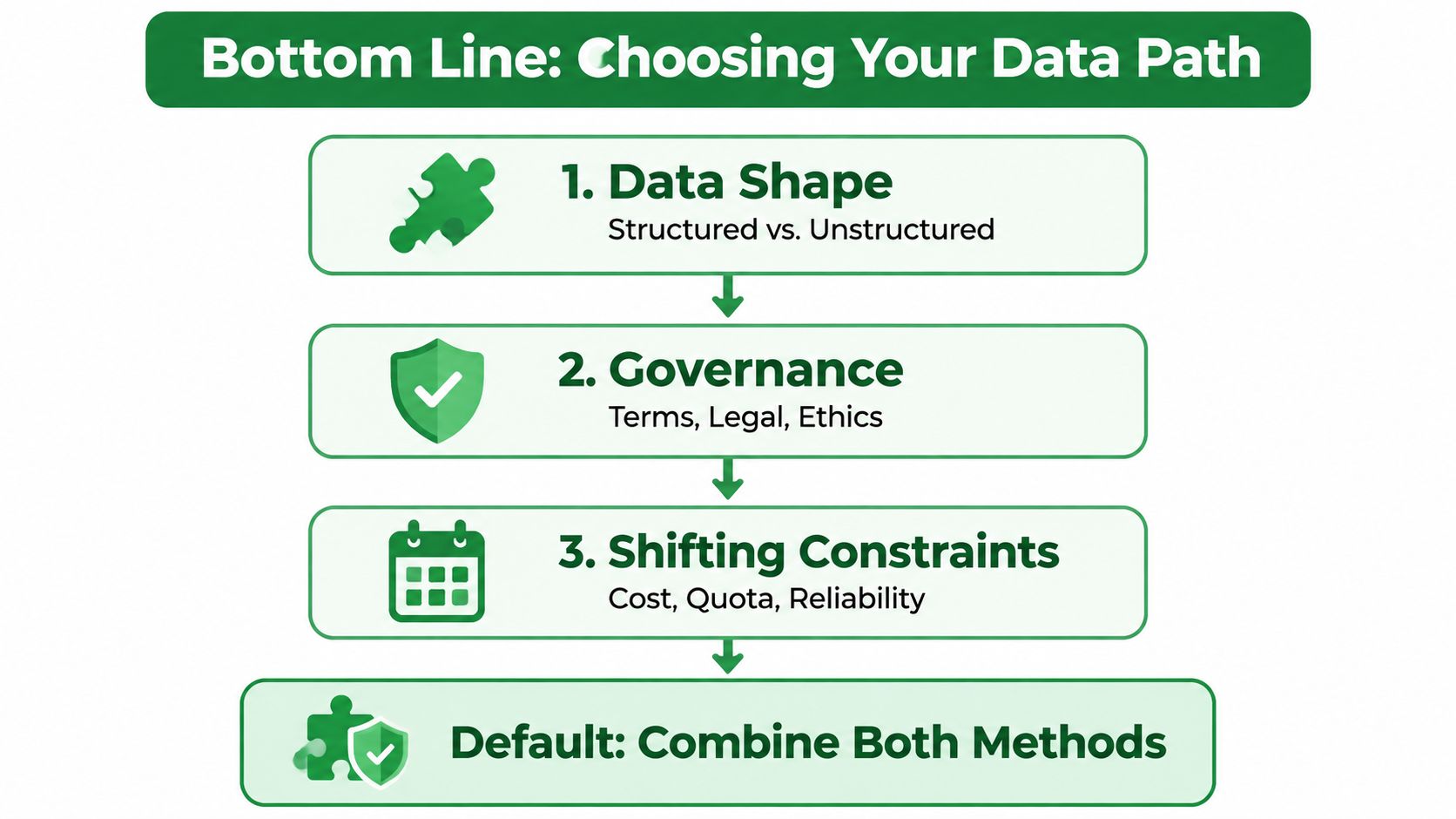
The heuristic is simple. If the source publishes structured endpoints with stable SLAs and your use case is transactional, take the API. If you need surface coverage the provider doesn't expose, plan for managed scraping as a first-class system, not as an emergency workaround. For most B2B teams, the mature answer is a hybrid architecture that treats extraction as infrastructure, not as a one-off task.
MapLeads turns public maps searches into exportable lead lists, with enrichment for emails, phones, websites, social profiles, and standardized business metadata. If your team is comparing API access with managed extraction for local prospecting or market coverage, visit MapLeads and review how its workflow fits a public-data pipeline.